
“AI Gap: How Artificial Intelligence Is Repeating the Mistakes of the Past”
By Amde Mitiku, Senior Localization Engineer & Founder at Ethiotrans
In the late 1990s, as the world was transitioning from analog to digital, I wrote to Bill Gates to highlight a major flaw in Microsoft’s software: the near-total neglect of non-Latin languages. At the time, many communities were forced to invent keyboard hacks and glyph substitutions just to communicate in their native tongues. It wasn’t until Windows NT and later Windows XP — with the introduction of Unicode — that real progress was made. But this came after decades of technological exclusion.
Now, nearly 30 years later, we are witnessing history repeat itself.
The New Divide: The “AI Gap”
Artificial Intelligence is becoming an everyday tool — shaping education, communication, business, and governance. But instead of leveling the playing field, it’s creating a new kind of inequality: an AI Gap — a divide between the empowered and the excluded, the paid and the free, the represented and the invisible.
Here’s how.
1. Two Classes of AI Users: Paid vs. Free
Many AI tools now offer different response quality based on user payment tiers. Free users receive shorter, less detailed responses. Paid users receive deeper insights, better formatting, and more timely results.
This is creating a knowledge inequality. If information access and quality depend on your ability to pay, then AI is not democratizing knowledge — it’s monetizing it.
2. Built-in Bias: Whose Voices Count?
Ask a simple question like “List countries around the world,” and you’ll likely see:
USA, UK, Germany, France, Australia…
But why this order?
Is it alphabetical? No.
Based on population? No.
GDP or military power? Possibly.
Developer bias? Most likely.
This is not a neutral list — it reflects the worldview of those who built or trained the system. This subtle bias shows up everywhere — from political summaries to language detection, from cultural references to historical prioritization.
3. The Developer’s Face is the AI’s Face
AI is not just an intelligence. It’s a mirror.
Behind every AI model is a developer, a data scientist, a curator. If that person (or company) is biased — intentionally or not — so is the AI.
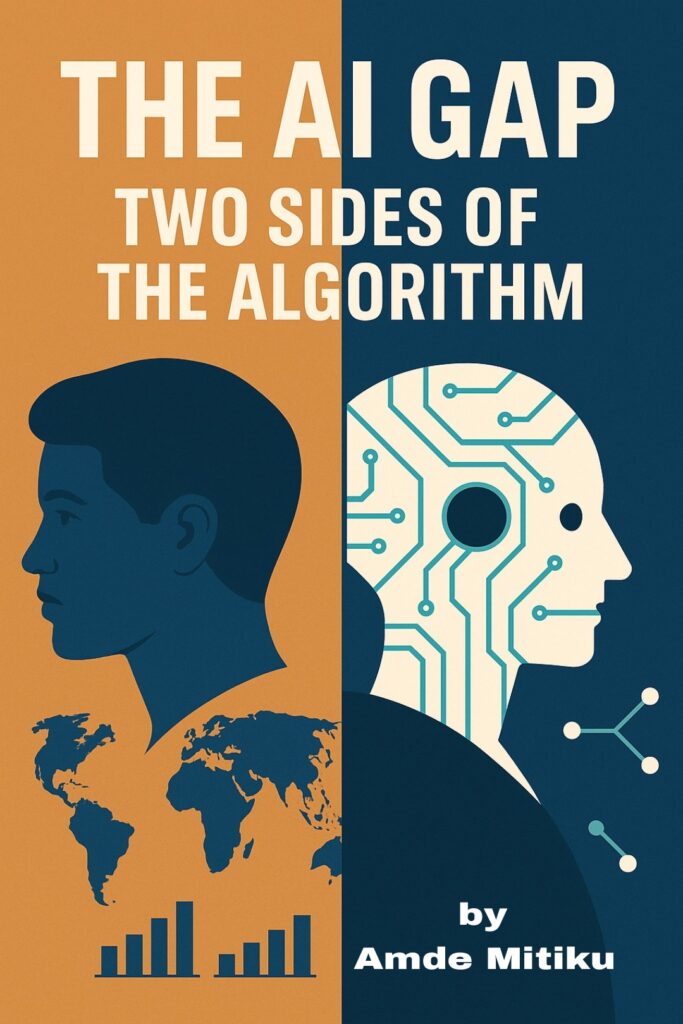
AI has two faces: the algorithm, and the person behind it.
If inclusion and fairness aren’t core values in its training, exclusion becomes the default behavior.
4. The Return of the Language Bottleneck
Today’s AI systems excel in European FIGS languages (French, Italian, German, Spanish) and in dominant Asian languages like Chinese, Japanese, and Korean. This follows the same pattern we saw in early computing.
Languages from Africa, the Middle East, Southeast Asia, and Indigenous communities are still afterthoughts — either mistranslated, misunderstood, or totally unsupported.
This is disturbingly similar to the days before Unicode — when only 128 characters could fit on a keyboard, and global scripts were excluded by design.
5. Global Means Everyone — Not Just the Majority
If AI is going to be a global tool, it must support global diversity:
Languages (written, spoken, and minority dialects)
Cultures (belief systems, expressions, customs)
Histories (not just Western-centric ones)
Politics and narratives (without reinforcing colonial frameworks)
As someone who’s worked on language inclusion for decades, I can say:
AI is not there yet. And unless we act, it will never get there.AI isn’t just a new technology—it’s a reflection of the past, coded into silicon. In many ways, AI is inheriting the historical biases and power structures that have long shaped global technology and knowledge systems. One stark example is the linguistic and cultural imbalance baked into many AI models today.
Much like the early days of computing, when Western companies prioritized FIGS languages (French, Italian, German, Spanish) and left billions without proper digital representation, today’s AI models show a similar trend. Back then, users of African, Middle Eastern, South Asian, and Indigenous languages had to create custom glyphs and keyboard layouts just to communicate digitally. It took decades and the introduction of Unicode for these languages to gain equal footing. Now, history may be repeating itse…
As a senior localization engineer who wrote to Microsoft in 1999 about their neglect of non-Latin scripts, I’ve watched this pattern unfold firsthand. It took more than 30 years for platforms like Windows to begin offering proper support. Now, AI threatens to replicate the same bottleneck, where access and representation are determined by economic and linguistic dominance—not inclusion.
In other words:
AI is inheriting the mistakes of the past.
It is unknowingly driven by colonial logic—favoring the powerful, the rich, and the dominant narratives—while marginalizing voices that fall outside its training data.
AI is the two-faced coin of its creator and its dataset. If either the developer or the data miner is biased, the entire system becomes biased. It is not neutral by default.
Until developers, data curators, and AI companies actively correct these imbalances, we are not building truly global intelligence—we are simply reinforcing the old hierarchy with a new, shinier interface.
THE AI GAP: TWO WORLDS, ONE SYSTEM
AI isn’t just a new technology—it’s a reflection of the past, coded into silicon. In many ways, AI is inheriting the historical biases and power structures that have long shaped global technology and knowledge systems. One stark example is the linguistic and cultural imbalance baked into many AI models today.
Much like the early days of computing, when Western companies prioritized FIGS languages (French, Italian, German, Spanish) and left billions without proper digital representation, today’s AI models show a similar trend. Back then, users of African, Middle Eastern, South Asian, and Indigenous languages had to create custom glyphs and keyboard layouts just to communicate digitally. It took decades and the introduction of Unicode for these languages to gain equal footing. Now, history may be repeating itse…
As a senior localization engineer who wrote to Microsoft in 1999 about their neglect of non-Latin scripts, I’ve watched this pattern unfold firsthand. It took more than 30 years for platforms like Windows to begin offering proper support. Now, AI threatens to replicate the same bottleneck, where access and representation are determined by economic and linguistic dominance—not inclusion.
In other words:
AI is inheriting the mistakes of the past.
It is unknowingly driven by colonial logic—favoring the powerful, the rich, and the dominant narratives—while marginalizing voices that fall outside its training data.
AI is the two-faced coin of its creator and its dataset. If either the developer or the data miner is biased, the entire system becomes biased. It is not neutral by default.
Until developers, data curators, and AI companies actively correct these imbalances, we are not building truly global intelligence—we are simply reinforcing the old hierarchy with a new, shinier interface.
Final Thought: The Choice Is Ours
AI is not destiny. It’s a design.
Developers, companies, and communities have a responsibility to ensure the next generation of technology doesn’t replicate the exclusion of the past. If we let market forces and convenience dictate everything, the AI Gap will grow wider than ever.
Let’s learn from history, not repeat it